Velvety Raspberry Cheesecake with Fresh Raspberry Sauce
Raspberries do something interesting when they cook down with a small amount of sugar: the seeds release a natural pectin that thickens the sauce on its own without cornstarch or gelatin. I noticed this the first time I made raspberry cheesecake sauce and have used it to my advantage ever since, letting the fruit do the work rather than reaching for a thickener.
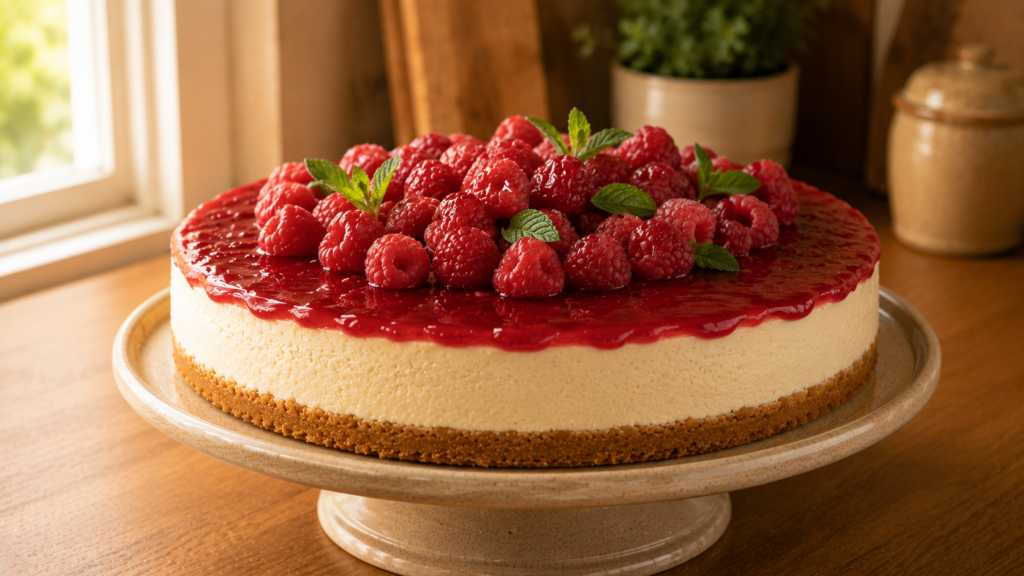
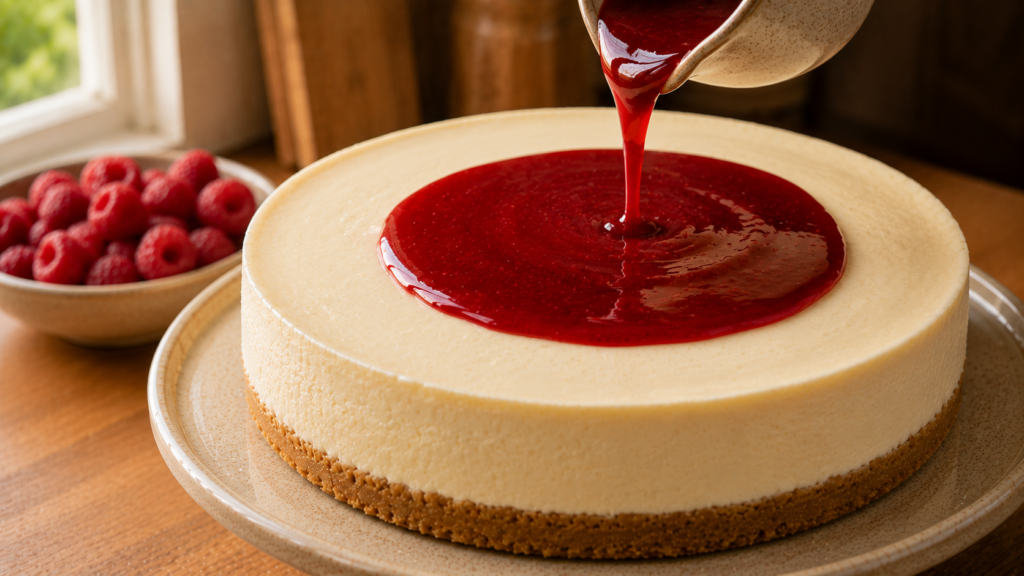
The result is a glossy, deeply colored sauce that sits cleanly on each slice without running.
Why You Will Love This Recipe
• The raspberry sauce is made entirely from fresh or frozen raspberries and sets to a glossy, spoonable consistency without any added thickeners.
• A vanilla and lemon zest filling brightens the cream cheese base so the cheesecake tastes light and fresh rather than heavy.
• The filling bakes in a water bath to a perfectly smooth, crack-free surface that needs no decoration to look elegant.
• Both the cheesecake and the raspberry sauce can be made up to two days ahead and assembled just before serving.
• The combination of tart raspberry and rich cream cheese works in every season, making this a cheesecake with no wrong occasion.
Ingredients
For the graham cracker crust:
• 1 and 1/2 cups graham cracker crumbs
• 3 tablespoons granulated sugar
• 1/3 cup unsalted butter, melted
• Pinch of salt
For the cheesecake filling:
• 3 packages (8 oz each) full-fat cream cheese, room temperature
• 1 cup granulated sugar
• 3 large eggs, room temperature
• 1/2 cup sour cream
• 1/3 cup heavy whipping cream
• 1 teaspoon vanilla extract
• 1 teaspoon fresh lemon zest
• 1 tablespoon fresh lemon juice
• 2 tablespoons all-purpose flour
For the fresh raspberry sauce:
• 2 cups fresh or frozen raspberries
• 1/3 cup granulated sugar
• 2 tablespoons water
• 1 teaspoon fresh lemon juice
For garnish:
• 1 cup fresh raspberries
• Fresh mint leaves (optional)

Crockery and Time To Create
• Equipment: 9-inch springform pan, stand mixer or hand mixer, large mixing bowl, medium saucepan, fine mesh sieve, roasting pan for water bath, heavy-duty aluminum foil, rubber spatula
• Prep time: 25 minutes
• Bake time: 60 to 65 minutes
• Cooling and chilling time: minimum 8 hours, overnight preferred
• Raspberry sauce time: 15 minutes
• Total active time: approximately 1 hour 45 minutes
• Servings: 12 slices
Ingredient Substitutions and Variations
• Fresh raspberries in sauce: Frozen raspberries work identically in the cooked sauce since the texture is irrelevant once simmered down. Use straight from frozen without thawing first.
• Lemon zest and juice: Lime zest and juice swap in directly for a slightly sharper, more tropical brightness that pairs equally well with raspberry.
• Sour cream in filling: Full-fat Greek yogurt replaces it without any change in texture or bake behavior.
• Heavy cream in filling: Evaporated milk works as a substitute and keeps the filling rich without adding extra fat.
• Graham cracker crumbs: Digestive biscuit crumbs or vanilla wafer crumbs produce a slightly sweeter, softer crust that still holds cleanly when sliced.
Step-by-Step Instructions
Step 1: Preheat your oven to 325 degrees F (165 degrees C). Grease a 9-inch springform pan and line the base with parchment paper. Wrap the entire outside of the pan tightly in two layers of heavy-duty aluminum foil, pressing the foil high up the sides to seal it completely against the water bath. Set aside.
Step 2: Mix the graham cracker crumbs, sugar, salt, and melted butter together until the crumbs are fully coated and hold together when pressed between your fingers. Press the mixture firmly and evenly into the base of the prepared pan using the flat bottom of a measuring cup. Bake for 10 minutes until lightly golden and fragrant. Remove and cool while you make the filling.
Step 3: Beat the room-temperature cream cheese on medium speed for 2 full minutes, scraping down the bowl halfway through, until the texture is completely smooth with no visible lumps. Add the sugar and flour and beat for 1 minute. Add the lemon zest, lemon juice, and vanilla and mix briefly to combine.
Step 4: Add the eggs one at a time on the lowest mixer speed, mixing only until each egg is just incorporated before adding the next. Once all three eggs are in, stop the mixer. Fold in the sour cream and heavy cream by hand with a rubber spatula until the batter is silky and uniform. Do not stir more than necessary.
Step 5: Pour the filling over the cooled crust and smooth the top with an offset spatula. Place the wrapped springform pan inside a large roasting pan and pour hot water around it to reach halfway up the outside of the springform. Slide the roasting pan carefully into the oven and bake for 60 to 65 minutes. The cheesecake is ready when the edges look set and slightly puffed while the center still has a gentle, uniform wobble when the pan is nudged.
Step 6: Turn the oven off and leave the cheesecake inside with the door cracked open about 2 inches for 1 hour. This slow cool-down prevents the sudden temperature change that causes cracking. After 1 hour, remove from the water bath, peel off the foil, run a thin knife around the inside edge of the springform, and refrigerate uncovered for at least 8 hours or overnight until completely set and cold throughout.
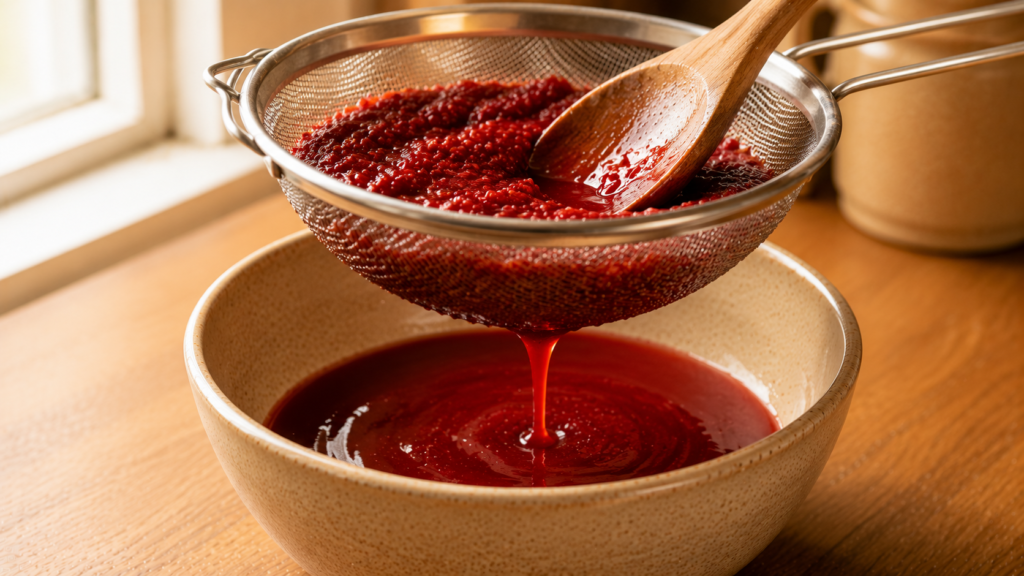
Step 7: Make the raspberry sauce while the cheesecake chills. Combine the raspberries, sugar, water, and lemon juice in a medium saucepan over medium heat. Cook, stirring occasionally, for 8 to 10 minutes until the raspberries have fully broken down and the mixture looks thick and syrupy. Pour through a fine mesh sieve into a bowl, pressing firmly with the back of a spoon to push through as much pulp as possible while leaving the seeds behind. Cool completely, then refrigerate until needed.
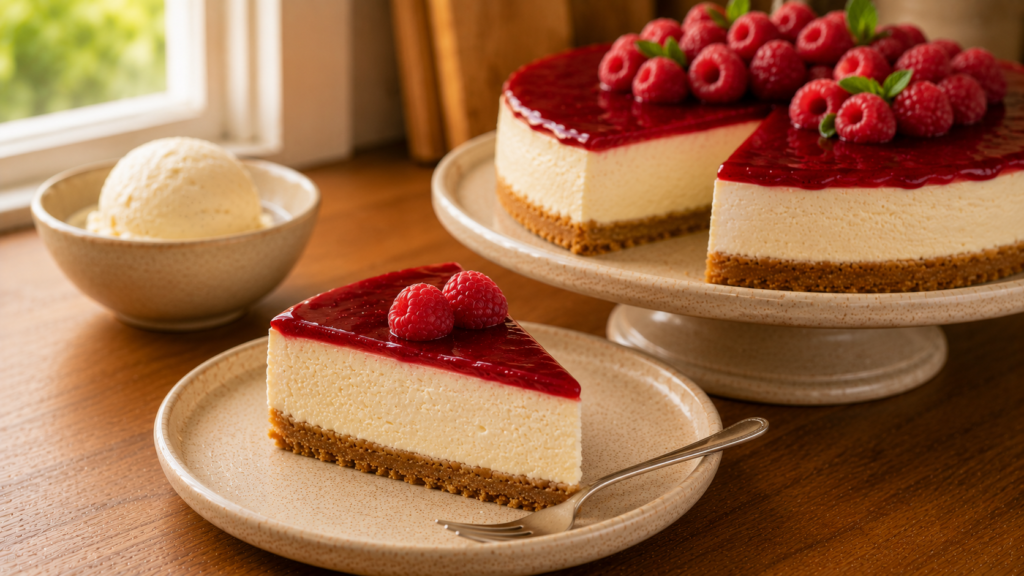
Step 8: To serve, release the springform sides and transfer the cheesecake to a serving plate. Spoon a generous layer of raspberry sauce across the top, letting it pool slightly toward the edges. Arrange fresh raspberries across the sauced surface and add a few mint leaves if using. Serve remaining sauce on the side for guests to add to individual slices.
Pro Tips for Best Results
• Bring the cream cheese to true room temperature, not just slightly softened; cold cream cheese never beats fully smooth and leaves dense pockets in the baked filling.
• Press the sieve firmly when straining the raspberry sauce to extract maximum pulp and color from the cooked berries, which produces a richer, more intensely flavored result.
• Add the lemon zest directly to the cream cheese batter before the eggs go in so the oils from the zest have time to bloom into the filling rather than sitting on the surface.
• Do not pour the water bath water directly onto the springform pan; pour it into the corner of the roasting pan so the stream does not splash onto the filling.
• Chill the raspberry sauce before spooning it over the cheesecake; a warm sauce will soften the top layer of the filling and make it difficult to place fresh raspberries neatly.
Common Mistakes to Avoid
• Skipping the fine mesh sieve for the sauce: An unstrained sauce has visible seeds that create a gritty texture on the palate and a less polished appearance on the finished cheesecake. The straining step takes 3 minutes and makes a significant difference.
• Over-mixing after the eggs are added: Every turn of the mixer after the eggs go in incorporates air into the batter, which causes the cheesecake to rise unevenly, then fall and crack as it cools. Mix eggs in on the lowest speed and stop as soon as each one disappears.
• Using low-fat cream cheese: Reduced-fat cream cheese contains more water and stabilizers that alter the texture of the baked filling, producing a looser, less creamy result. Full-fat is required for the right consistency.
• Topping with sauce while the cheesecake is still warm: A cheesecake that has not fully chilled will absorb the sauce into the surface rather than holding it on top, and the filling will be too soft to support the fresh raspberries without them sinking.
• Forgetting the parchment liner: Without parchment on the base, the crust fuses to the springform pan bottom and the cheesecake cannot be cleanly transferred to a serving plate.
What to Serve With
• A scoop of vanilla bean ice cream alongside: The cold, creamy contrast against the tart raspberry sauce and rich filling turns a single slice into a composed dessert plate without any extra effort.
• Prosecco or a dry sparkling rose: The light effervescence and fruit notes in sparkling wine amplify the raspberry flavor without competing with the cream cheese richness.
• Freshly whipped unsweetened cream on the side: A spoonful of plain whipped cream cuts the tartness of the raspberry sauce and gives guests a way to adjust the balance of each bite to their preference.
Storage and Reheating
• Refrigerator: Store the plain cheesecake covered with plastic wrap or under a cake dome for up to 5 days. Keep the raspberry sauce in a separate sealed jar in the refrigerator for up to 5 days and add fresh raspberries only at serving time.
• Freezer: Freeze the plain cheesecake without any topping, wrapped tightly in plastic wrap then in foil, for up to 2 months. Thaw overnight in the refrigerator and add sauce and fresh raspberries just before serving.
• Raspberry sauce: The cooked strained sauce keeps refrigerated in a sealed jar for up to 1 week and can also be frozen for up to 3 months.
• Do not reheat: Serve cold directly from the refrigerator. Warming cheesecake softens the filling and causes the fresh raspberry garnish to release liquid onto the surface.
Nutrition Information
| Nutrient | Per Serving |
| Calories | 355 kcal |
| Total Fat | 23g |
| Saturated Fat | 13g |
| Cholesterol | 100mg |
| Sodium | 280mg |
| Total Carbohydrates | 32g |
| Dietary Fiber | 2g |
| Sugars | 22g |
| Protein | 7g |
| * Percent daily values are based on a 2,000 calorie diet. Nutritional values are estimates only and may vary based on specific ingredients and portion sizes used. | |
Health Benefits
Raspberries rank among the highest fiber fruits per cup, with a significant portion of that fiber coming from the seeds, which the sauce straining step removes. Even so, the cooked raspberry pulp retains its antioxidant content, particularly ellagic acid and quercetin, compounds studied for their role in protecting cells from oxidative damage and supporting cardiovascular health.
The lemon juice and zest in the filling contribute vitamin C and limonene, a compound found in citrus peel that has been researched for its antioxidant and anti-inflammatory properties. Full-fat dairy in the form of cream cheese and sour cream provides fat-soluble vitamins A and D alongside calcium in each serving.
Conclusion
This raspberry cheesecake is the recipe I pull out when I want something that looks like it required far more effort than it actually did. The smooth filling, the glossy sauce, and the fresh raspberry garnish combine into a dessert that photographs well, travels to a table beautifully, and holds up in the refrigerator for days without losing anything. Make it the night before, keep the sauce separate until serving, and let the fruit do the talking when you spoon it over at the table.