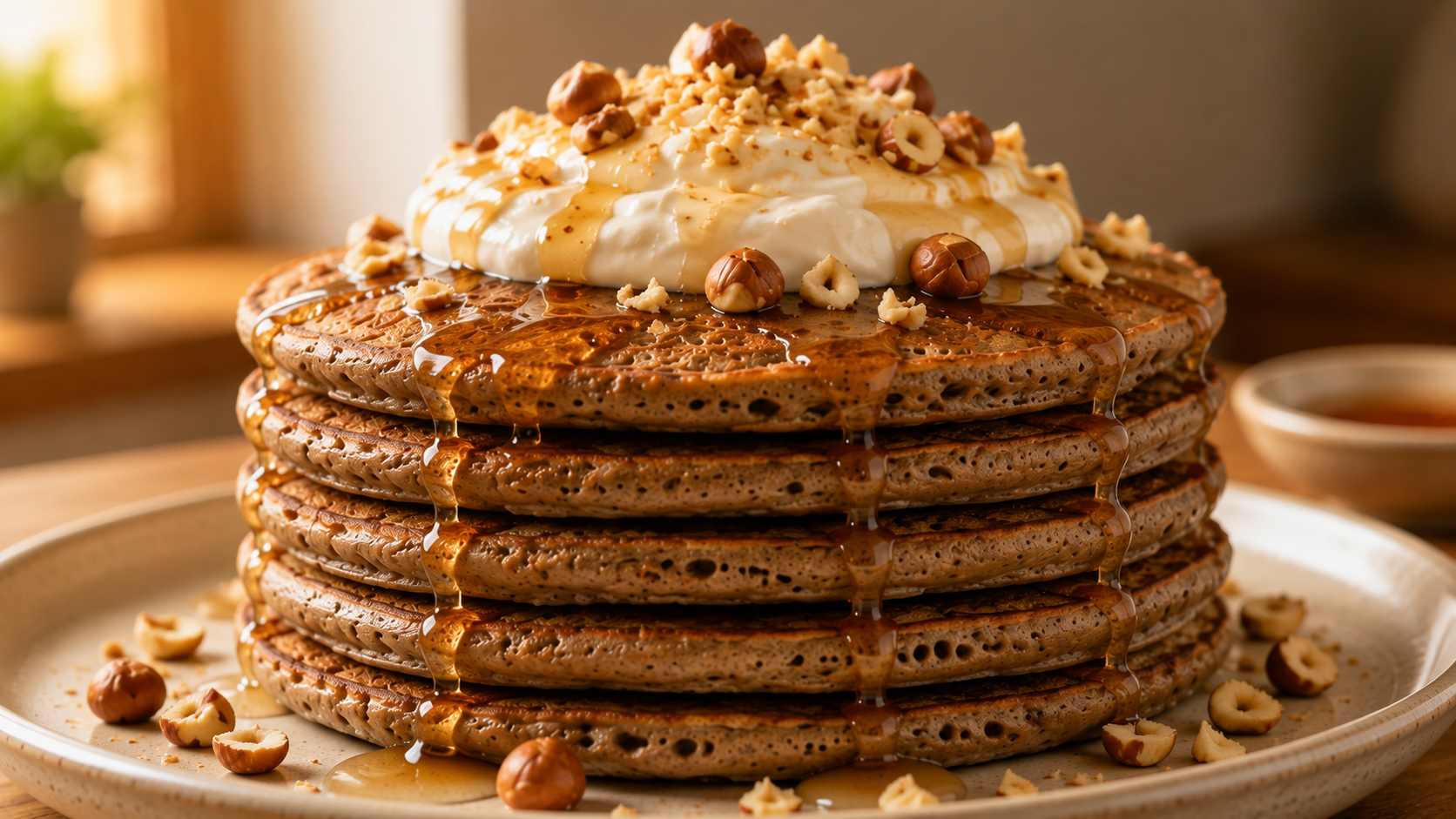
Nutty Overnight Buckwheat Pancakes with Honey and Creme Fraiche
Buckwheat cakes were raised overnight with yeast for a century before baking powder reached most kitchens. That slow ferment is not nostalgia. It softens buckwheat’s tannic edge and builds a flavour no quick batter reaches.
These Buckwheat Pancakes take five minutes at night and fifteen in the morning.
Why You Will Love This Recipe
- The overnight ferment mellows the bitterness that puts most people off buckwheat and replaces it with a deep, malty, almost sourdough tang.
- Buckwheat is not wheat at all, so this recipe is naturally gluten free while still producing a tender pancake with real structure.
- You do the work the night before in one bowl, which leaves fifteen minutes of actual cooking between waking up and eating.
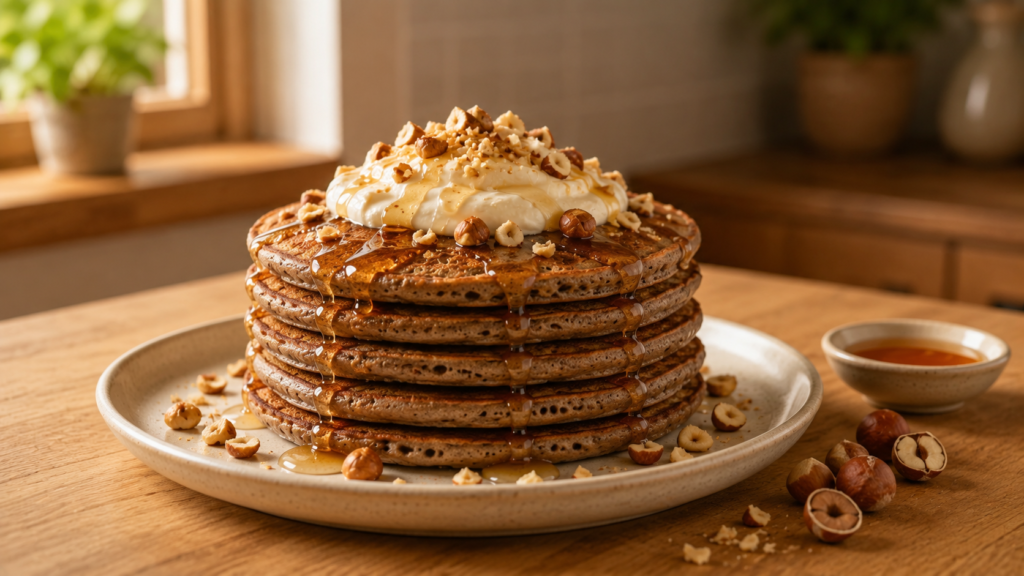
- The cooked surface develops a distinctive lacy, pitted texture from the fermentation that no baking powder batter can imitate.
- Cool tangy creme fraiche against warm earthy buckwheat and floral honey is one of the better three ingredient combinations in breakfast cooking.
Ingredients
For the overnight sponge
- 1 and 1/2 cups light buckwheat flour, not dark or whole groat flour
- 1 and 1/2 cups whole milk, warmed to 105F to 110F
- 1 teaspoon instant yeast
- 1 tablespoon pure maple syrup
For the morning batter
- 2 large eggs, at room temperature
- 3 tablespoons unsalted butter, melted and cooled to lukewarm
- 3/4 teaspoon fine sea salt
- 1/2 teaspoon baking soda
- 1 teaspoon pure vanilla extract
- 2 to 4 tablespoons whole milk, only if needed
For cooking
- 2 tablespoons unsalted butter, added in stages
For serving
- 3/4 cup creme fraiche, at room temperature
- 1/3 cup wildflower or buckwheat honey, gently warmed
- 1/3 cup hazelnuts, toasted and roughly chopped
Crockery and Time To Create
You will need a large mixing bowl with room for the sponge to double, a plate or loose cover for the bowl, a balloon whisk, a rubber spatula, a small saucepan for warming the honey, a small dry skillet for the hazelnuts, a quarter cup measure, a thin flexible metal spatula, and a wide carbon steel skillet with a matte dark grey surface.
Prep time is 5 minutes the night before and 10 minutes in the morning. Fermenting time is 8 to 12 hours. Cook time is 16 minutes. Total time is 8 hours 31 minutes at the shortest. This makes 12 pancakes, which serves 4 people at 3 pancakes each.
Ingredient Substitutions and Variations
- Dark buckwheat flour: Swap in dark buckwheat for a much stronger, earthier result, but expect a considerably more assertive flavour and a heavier crumb.
- Half and half with all purpose: Swap 1/2 cup of the buckwheat flour for all purpose when you want a milder introduction, accepting that the recipe is no longer gluten free.
- Almond milk: Swap the whole milk for unsweetened almond milk in both stages, which ferments perfectly well and suits the nutty flavour.
- Greek yogurt: Swap the creme fraiche for plain whole milk Greek yogurt when you want more tang and more protein.
- Maple syrup: Swap the honey for pure maple syrup for a rounder, less floral sweetness that leans into the malty notes.
- Toasted walnuts or pecans: Swap the hazelnuts for either, both of which toast in the same time and carry the same bitter edge that suits buckwheat.
- Sourdough starter: Swap the yeast for 1/4 cup of active starter for an even deeper tang, extending the ferment to a full 12 hours.
Step-by-Step Instructions
Build the Sponge the Night Before
- Warm the milk to 105F to 110F, comfortably warm on the inside of your wrist and never hot enough to sting.
- Whisk the buckwheat flour, yeast, and maple syrup into the warm milk in a large bowl until you have a smooth batter roughly the consistency of thick cream, with no dry pockets of flour at the base.
- The batter will be a soft grey lavender colour, which is normal for light buckwheat flour and not a sign that anything is wrong.
Cover Loosely and Ferment Overnight
- Cover the bowl with a plate rested on top rather than sealing it tightly, since fermenting batter needs a little air exchange.
- Leave it at cool room temperature for 8 to 12 hours. Choose a bowl at least twice the volume of the batter, because it will rise considerably before settling.
- If your kitchen runs warm above 75F, use the shorter end of that window or the batter will over ferment and turn sharply sour.
Stir Down the Risen Sponge
- In the morning the surface should be domed, covered in fine bubbles, and smelling distinctly yeasty and slightly sour, with a visible tide line on the bowl wall showing how far it rose.
- Stir it down with a whisk in slow circles. The foam will collapse and the volume will drop by roughly a third, which is exactly what should happen.
- If the surface is flat with no bubbles at all, the yeast was inactive and the batter will not perform. Start again rather than pressing on.
Whisk In the Morning Ingredients
- Whisk the eggs, cooled melted butter, salt, and vanilla into the stirred down sponge until smooth and uniform.
- Sprinkle the baking soda across the surface and whisk it in last, which will foam gently as it meets the acidity built up overnight.
- The batter should now pour in a thick steady ribbon. Add milk a tablespoon at a time only if it is too thick to pour, since overnight thickness varies with flour and room temperature.
Toast the Hazelnuts and Warm the Honey
- Toast the hazelnuts in a dry skillet over medium heat for 4 to 5 minutes, tossing every 30 seconds, until they smell nutty and the skins have darkened and begun to split.
- Tip them onto a plate immediately, let them cool, then rub the loose skins away in a coarse sieve and chop roughly.
- Warm the honey in a small saucepan over the lowest heat for about a minute, just until it loosens and pours freely. Do not let it simmer.
Heat the Skillet and Test It
- Set the carbon steel skillet over medium heat and let it come up for 3 minutes, then add a small knob of butter.
- Flick a drop of water onto the surface. It should sizzle steadily and travel across the pan rather than crack and vanish instantly.
- Buckwheat can take slightly more heat than a banana or oat batter, so medium rather than medium low is right here.
Cook and Watch for the Lacy Surface
- Pour a scant quarter cup per pancake and leave them undisturbed for 2 to 3 minutes.
- Watch for the surface to open into a distinctive pitted lacy pattern as the fermentation bubbles burst, which is the visual signature of this batter and your cue that the underside is ready.
- Flip once when the edges have set matte and the underside is a deep even brown, then cook 1 to 2 minutes more. The interior crumb should be a soft greyish lavender brown, noticeably lighter than the dark browned exterior.
Stack and Assemble
- Stack the pancakes as they come off the skillet, keeping the most evenly browned one for the top.
- Spoon the room temperature creme fraiche over the top of the stack in one generous mound, letting it slump naturally rather than spreading it flat.
- Drizzle the warm honey over everything and scatter the toasted chopped hazelnuts across the top. Serve immediately.
Pro Tips for Best Results
- Buy light buckwheat flour rather than dark, because dark flour is milled with more of the hull and its bitterness survives even a full overnight ferment.
- Choose a bowl that looks comically oversized for the amount of batter, since an overflowing sponge at three in the morning is a genuinely unpleasant surprise.
- Smell the sponge before using it. Pleasantly yeasty and mildly sour is right, while sharply acetic or nail polish sharp means it went too long and should be discarded.
- Add the baking soda at the very end rather than the night before, since it needs the accumulated acidity to react and will do nothing if added early.
- Let the creme fraiche sit out while you cook, because cold creme fraiche seizes on contact with a hot pancake instead of slumping softly.
Common Mistakes to Avoid
- Using dark buckwheat flour: The bitterness is far stronger and no amount of fermenting will fully soften it. Light buckwheat flour is what this recipe is built around.
- Sealing the bowl airtight: Fermentation needs air exchange, and a tight lid produces a flat, sluggish sponge. Rest a plate on top instead.
- Fermenting in a warm kitchen for twelve hours: Above 75F the batter turns sour and unpleasant well before the twelve hour mark. Use eight to ten hours instead.
- Skipping the stir down: Pouring the risen foam straight onto the pan gives uneven pancakes with large hollow pockets. Collapse it first.
- Adding the baking soda the night before: It reacts immediately and is spent by morning. It goes in last, right before cooking.
- Cooking on low heat: Buckwheat needs enough heat to develop the lacy surface. Too low and you get a flat, pale, slightly gummy pancake.
What to Serve With
- Sliced ripe pears: Their soft floral sweetness sits beautifully against the earthiness of buckwheat and works better here than a sharp berry would.
- A soft aged cheese: A small wedge of something mild and creamy alongside plays to buckwheat’s savoury side, which is how it is eaten across most of Europe.
- Black tea with milk: The tannins in the tea meet the tannins in the buckwheat, and it suits the malty flavour far better than coffee.
Storage and Reheating
- Sponge storage: The unfermented sponge can be held in the fridge for up to 24 hours instead of at room temperature, giving a slower and milder ferment.
- Fridge: Store cooled pancakes in an airtight container with parchment between the layers for up to 4 days.
- Freezer: Freeze in a single layer on a tray until solid, then transfer to a freezer bag for up to 2 months.
- Reheating from the fridge: Warm in a dry skillet over medium low heat for 90 seconds per side, which restores the lacy surface texture.
- Reheating from frozen: Toast directly from frozen on a low setting, or warm at 300F for 8 minutes.
Nutrition Information
| Nutrient | Per Serving |
|---|---|
| Calories | 572 kcal |
| Total Fat | 31 g |
| Saturated Fat | 15 g |
| Cholesterol | 142 mg |
| Sodium | 548 mg |
| Total Carbohydrate | 61 g |
| Dietary Fiber | 6 g |
| Total Sugars | 28 g |
| Protein | 14 g |
| Magnesium | 148 mg |
| Iron | 3 mg |
| Nutrition values are estimates calculated per serving of 3 pancakes with creme fraiche, honey, and hazelnuts, and will vary based on the flour milling, honey quantity, and exact ingredients used. | |
Health Benefits
Buckwheat contains rutin, a flavonoid found in very few other everyday foods, which has been studied for its role in supporting capillary strength and circulation. It also delivers all nine essential amino acids, which is genuinely unusual for a plant food and rare among anything used as a flour.
The overnight ferment does real nutritional work beyond flavour. It begins breaking down phytic acid, the compound in whole grains and seeds that binds minerals and limits their absorption, which makes the magnesium and iron in buckwheat more available than they would be in a quick batter.
Conclusion
Buckwheat divides people, and I think most of that comes down to having only ever met it in a rushed batter. Give it the overnight ferment, keep it to light flour, and pair it with something cool and tangy. Make the sponge tonight and save the recipe if the lacy surface turns out the way it should.