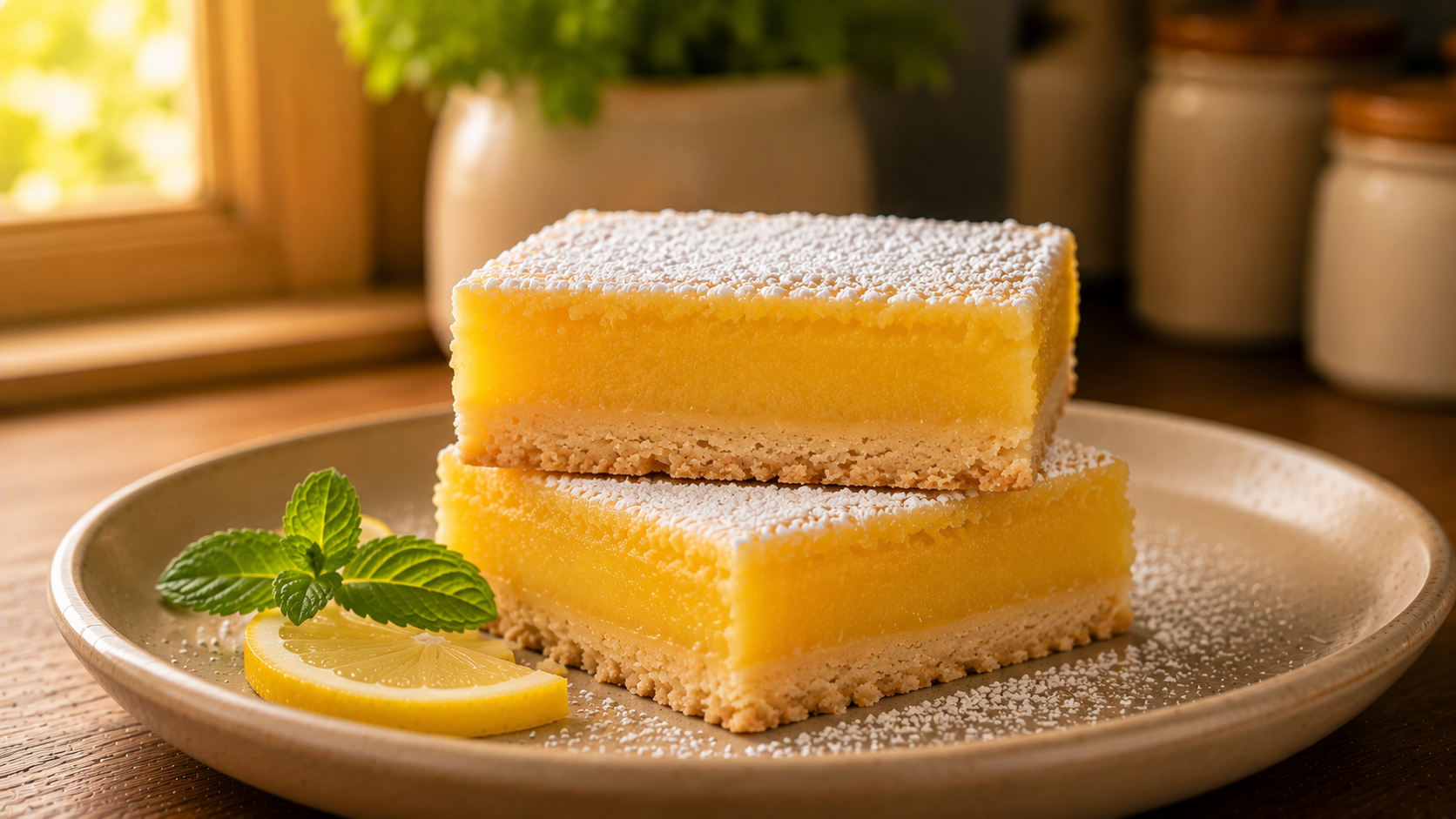
Classic Lemon Bars With a Thick Buttery Shortbread Crust
Lemon bars taught me the difference between a recipe that just works and one that actually delivers on its promise. I have tested this version more times than I can count, adjusting the curd-to-crust ratio until the lemon layer was thick enough to hold its shape without wobbling and tart enough to make you pause at the first bite.
The shortbread base is the part most recipes get wrong. It needs to be baked blind until genuinely golden before the curd goes in, otherwise the bottom stays soft and the whole bar collapses when you cut it. Get that step right and the rest follows easily.
Why You Will Love This Recipe
- The lemon curd layer is thick, silky, and properly tart, made with fresh lemon juice only, no concentrates or shortcuts.
- The shortbread crust bakes up crisp, buttery, and sturdy enough to hold a clean slice without crumbling.
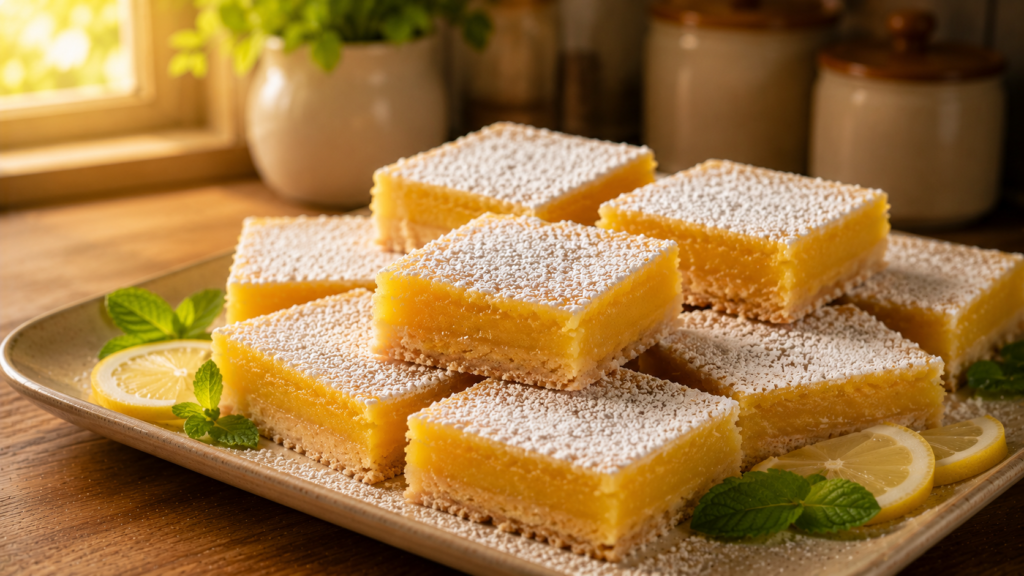
- These lemon bars set firmly in the refrigerator and cut into clean, sharp squares that hold their shape beautifully on a platter.
- The recipe uses a single baking pan and minimal equipment, making cleanup as straightforward as the method itself.
- They work equally well as an everyday treat, a dinner party dessert, or a summer potluck contribution that travels without issue.
Ingredients
For the shortbread crust:
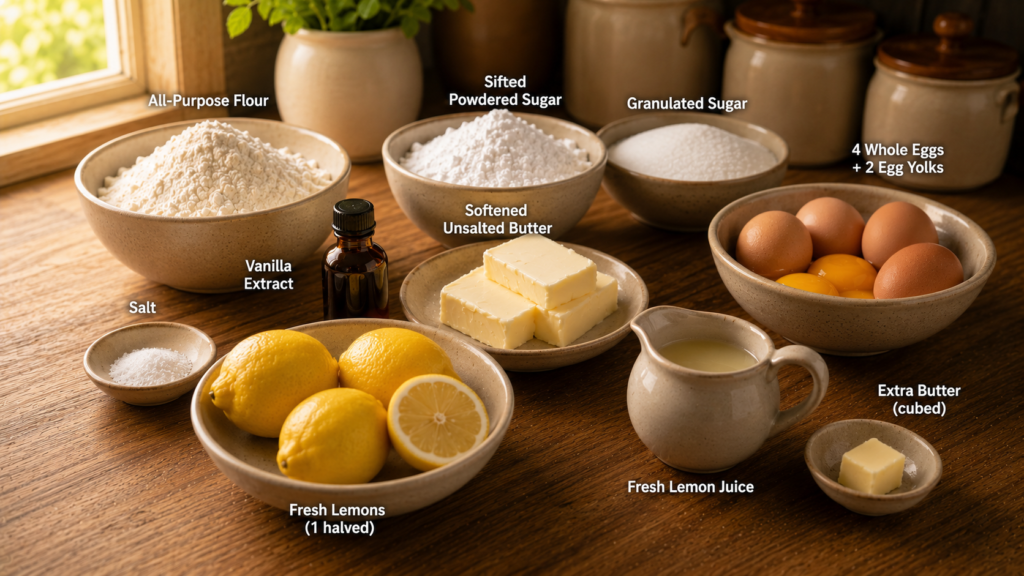
- 1 cup (225g) unsalted butter, softened to room temperature
- 1/2 cup (60g) powdered sugar, sifted
- 2 cups (250g) all-purpose flour
- 1/4 teaspoon salt
- 1 teaspoon pure vanilla extract
For the lemon curd filling:
- 4 large eggs plus 2 egg yolks, room temperature
- 1 and 1/2 cups (300g) granulated sugar
- 1/2 cup (120ml) fresh lemon juice (approximately 4 to 5 lemons)
- Zest of 3 lemons
- 1/4 cup (30g) all-purpose flour
- Pinch of salt
- 2 tablespoons unsalted butter, cubed
To finish:
- Powdered sugar for dusting
- Thin lemon slices or candied lemon zest for garnish (optional)
Crockery and Time To Create
Equipment needed: 9×13 inch baking pan, parchment paper, stand mixer or hand mixer, two mixing bowls, citrus juicer, microplane or fine grater for zesting, whisk, rubber spatula, fine mesh sieve, wire cooling rack.
Prep time: 20 minutes Bake time: 40 to 45 minutes total (20 minutes crust, 22 to 25 minutes filling) Chill time: 2 hours minimum Total time: approximately 3 hours including chilling Servings: 20 to 24 bars depending on cut size
Ingredient Substitutions and Variations
- Fresh Lemon Juice: Bottled lemon juice is a hard no here. The flavor falls flat and the curd will taste one-dimensional. Fresh juice is non-negotiable for lemon bars worth making.
- All-Purpose Flour (in curd): Cornstarch at half the quantity (2 tablespoons) can replace the flour in the filling for a slightly more translucent, jiggly curd if you prefer a softer set.
- Granulated Sugar (in curd): Reducing to 1 and 1/4 cups makes the bars noticeably more tart, which many people actually prefer. Start there if you enjoy a bold lemon punch.
- Unsalted Butter (crust): European-style butter with higher fat content makes the crust richer and more tender. Worth using if you have access to it.
- Lemon: Replacing half the lemon juice with fresh lime juice creates a citrus hybrid that is bright, slightly more floral, and unexpectedly popular.
- Powdered Sugar Dusting: A very light coating of flaked sea salt in addition to the powdered sugar adds a contrast that makes the lemon flavor hit much harder.
Step-by-Step Instructions
Step 1: Prepare your pan and preheat. Set your oven to 350°F (175°C). Line your 9×13 inch baking pan with parchment paper, leaving enough overhang on the long sides to use as handles when lifting the finished bars out. Lightly butter the short sides where the parchment does not reach.
Step 2: Make the shortbread crust. Beat the softened butter and powdered sugar together on medium speed for 2 minutes until pale and smooth. Add the vanilla extract and mix briefly. Add the flour and salt and mix on low just until the dough comes together into a soft, crumbly mass. It will look dry at first but press it together with your hands and it will hold.
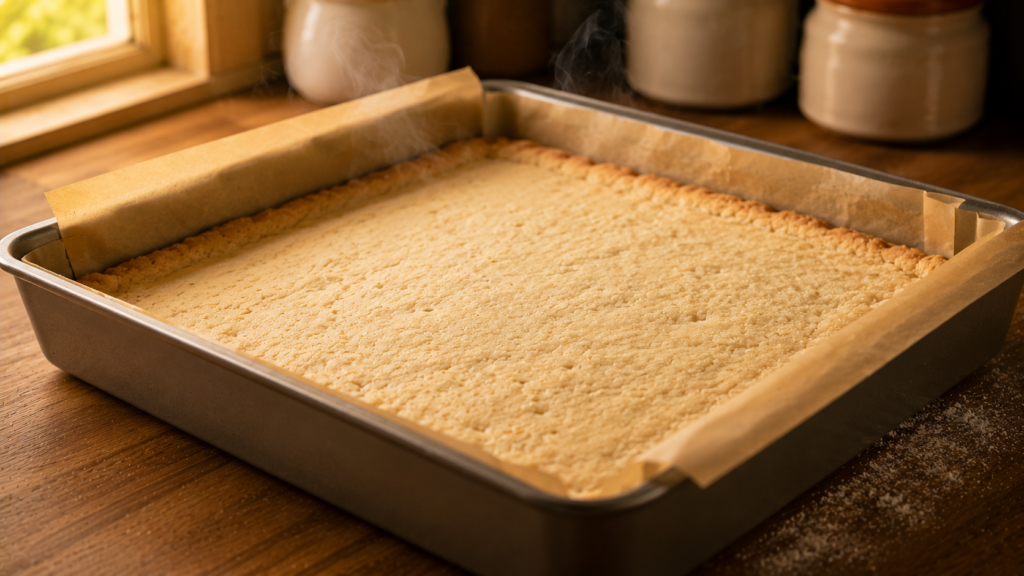
Step 3: Press and blind bake the crust. Tip the dough into the prepared pan and press it out firmly and evenly across the entire base using the flat bottom of a measuring cup or a glass. The layer should be uniformly thick, roughly 1/4 inch. Bake for 18 to 20 minutes until the crust is pale golden at the edges and just set in the center. Remove from the oven and let it rest for 5 minutes while you make the filling. Do not turn the oven off.
Step 4: Make the lemon curd filling. In a large bowl, whisk together the eggs, egg yolks, and granulated sugar until smooth and slightly paler in color, about 1 minute. Add the lemon juice, lemon zest, flour, and salt and whisk again until fully combined with no lumps. Pass the mixture through a fine mesh sieve to catch any zest pieces or egg bits, which ensures a completely smooth, clean curd.
Step 5: Add the butter. Whisk the cubed butter into the sieved curd mixture. It will not melt yet at this stage, but it will melt into the curd during baking and enrich the finished texture significantly.
Step 6: Pour and bake. Pour the lemon filling directly over the warm shortbread crust. The crust does not need to be cold. Slide the pan carefully back into the oven and bake for 22 to 25 minutes until the filling is set at the edges with just a slight jiggle in the very center, similar to a cheesecake at the done stage. The surface should look matte rather than wet.
Step 7: Cool completely then chill. Remove from the oven and let the pan cool at room temperature for 1 hour. Then transfer to the refrigerator and chill for a minimum of 2 hours, or overnight for the cleanest possible slices. Do not try to cut them warm.
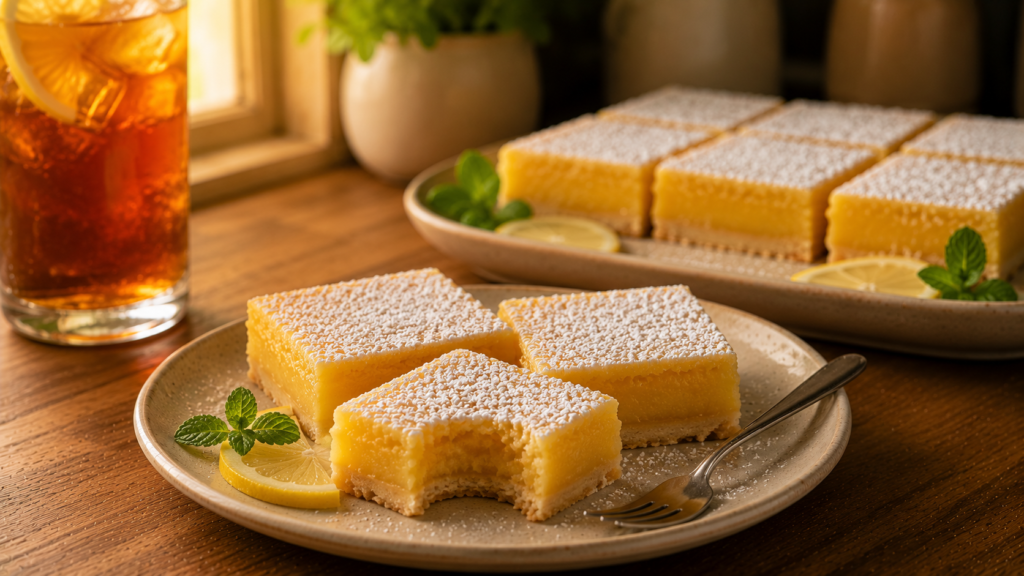
Step 8: Slice and finish. Lift the entire slab out of the pan using the parchment handles. Use a sharp knife wiped clean between every single cut to get sharp, clean edges. Dust generously with sifted powdered sugar just before serving. Garnish with a thin lemon slice or a curl of candied zest on each bar if you want a more finished presentation.
Pro Tips for Best Results
- Zest your lemons before juicing them. Once a lemon is juiced, zesting it is nearly impossible and you will lose the aromatic oils that give lemon bars their brightness.
- Sieve the curd filling without fail. Any bits of egg white or large pieces of zest will show as imperfections on the surface of the finished bars.
- Let the crust cool for 5 minutes before adding the filling, but do not let it go fully cold. A warm crust helps the curd adhere to the base and prevents the two layers from separating when you cut.
- Always wipe the knife between cuts. Even one smeared cut drags lemon curd across the powdered sugar and the whole presentation suffers.
- Dust the powdered sugar only just before serving, not before. Powdered sugar absorbs moisture from the lemon layer within an hour and becomes invisible.
- For perfectly uniform bars, score the surface lightly with a ruler and toothpick before making your cuts.
Common Mistakes to Avoid
- Underbaking the shortbread crust. A pale, soft, underbaked crust will turn soggy the moment the wet lemon filling goes on top. It needs 18 to 20 full minutes and genuine golden color at the edges before it is ready.
- Using bottled lemon juice. Bottled juice lacks the volatile aromatic compounds that make fresh lemon curd taste alive. The bars will be flat and one-note no matter how well everything else is executed.
- Overbaking the curd layer. An overbaked lemon filling turns grainy, loses its silky texture, and sometimes cracks across the surface as it cools. Pull it out the moment the center has that gentle jiggle.
- Cutting before fully chilled. Warm lemon bars will smear, collapse at the edges, and lose their clean layers entirely. Two hours in the refrigerator is a minimum, not a suggestion.
- Dusting powdered sugar too early. The sugar dissolves into the moist lemon surface within an hour. Always dust immediately before plating and serving.
What to Serve With
- Unsweetened whipped cream: A small cloud of whipped cream alongside a lemon bar softens the tartness beautifully without adding competing sweetness.
- Fresh berries: Raspberries or blueberries scattered on the serving plate add color contrast and a natural sweetness that pairs with lemon in a way that feels complete and intentional.
- Iced Earl Grey tea: The bergamot notes in Earl Grey are a natural companion to lemon, and a cold glass alongside these bars makes for one of the most effortless elegant afternoon pairings I know.
Storage and Reheating
- Refrigerator: Store in an airtight container or covered tightly with plastic wrap for up to 5 days. Dust with fresh powdered sugar after removing from the refrigerator each time before serving.
- Stacking: Place a sheet of parchment paper between layers if stacking in a container. The powdered sugar will transfer and the curd surface can stick.
- Freezer: Freeze undusted bars in a single layer on a baking sheet until solid, then transfer to an airtight freezer bag for up to 3 months. Thaw overnight in the refrigerator and dust with fresh powdered sugar before serving.
- Reheating: These are best served cold or at room temperature. Do not microwave, as the curd layer will separate and turn watery.
Nutrition Information
| Nutrient | Per Serving (1 bar) |
|---|---|
| Calories | 198 kcal |
| Total Fat | 9.8g |
| Saturated Fat | 5.9g |
| Carbohydrates | 27.3g |
| Sugar | 18.6g |
| Protein | 2.9g |
| Fiber | 0.3g |
| Sodium | 78mg |
| Nutrition values are estimates based on standard ingredients. Actual values may vary depending on brands and portion sizes used. | |
Health Benefits
Fresh lemon juice is one of the most accessible sources of vitamin C in everyday baking. A single lemon bar made with real juice delivers a meaningful contribution of this antioxidant vitamin, which supports immune function and aids the absorption of iron from plant-based foods consumed alongside it.
Eggs, which form the backbone of the lemon curd layer, provide high-quality complete protein along with choline, a nutrient critical for brain health and liver function that many people do not get in sufficient amounts from their regular diet. These bars are an indulgence, but not an empty one.
Conclusion
Lemon bars are one of those recipes that rewards patience more than skill. Get the crust golden, sieve the curd, chill them properly, and cut them cold, and you will have bars that look and taste like they came from a proper bakery. This classic lemon bars recipe is the one I keep coming back to every spring and summer, and I hope it earns a permanent spot in your rotation too. Save it, share it with someone who loves citrus, and let me know how cleanly yours slice.