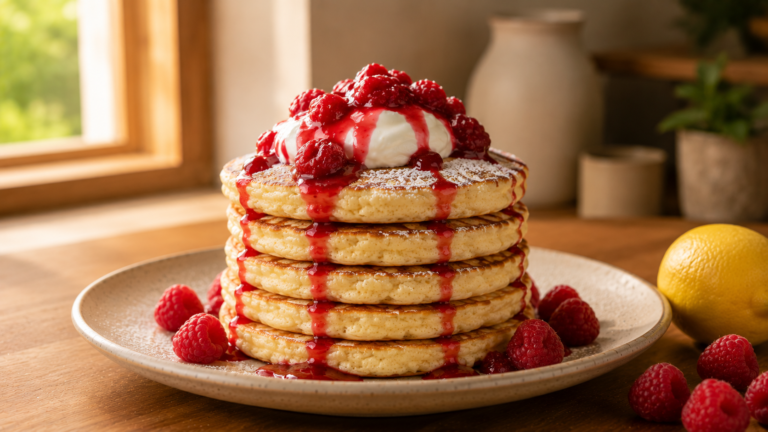
Tender Coconut Flour Pancakes with Whipped Cream and Toasted Flakes
Six eggs to half a cup of flour sounds like a mistake. It is the correct ratio. Coconut flour absorbs several times its own weight in liquid, so it needs far more egg and far less flour than any other pancake you have made.
Coconut Flour Pancakes fail almost entirely on that one point.
Why You Will Love This Recipe
- Six eggs give these twenty grams of protein per serving, which is more than double what a standard wheat pancake delivers and enough to keep you full for hours.
- Coconut flour is naturally grain free and gluten free with only nine grams of net carbs per serving, so it fits keto, paleo, and low carb eating without tasting restrictive.
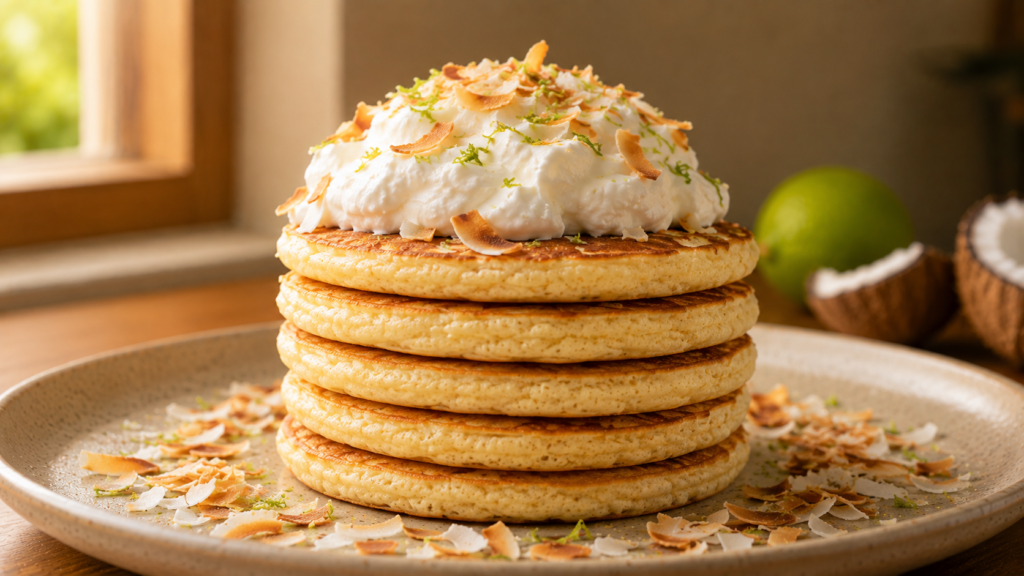
- Whipped coconut cream and toasted flakes on top double down on the coconut instead of fighting it, and the lime zest keeps the whole plate from reading flat.
- Half a cup of flour makes twelve pancakes, so this is one of the cheaper grain free breakfasts once you have the bag.
- The batter takes six minutes and the rest is just patience with the heat.
Ingredients
For the pancakes
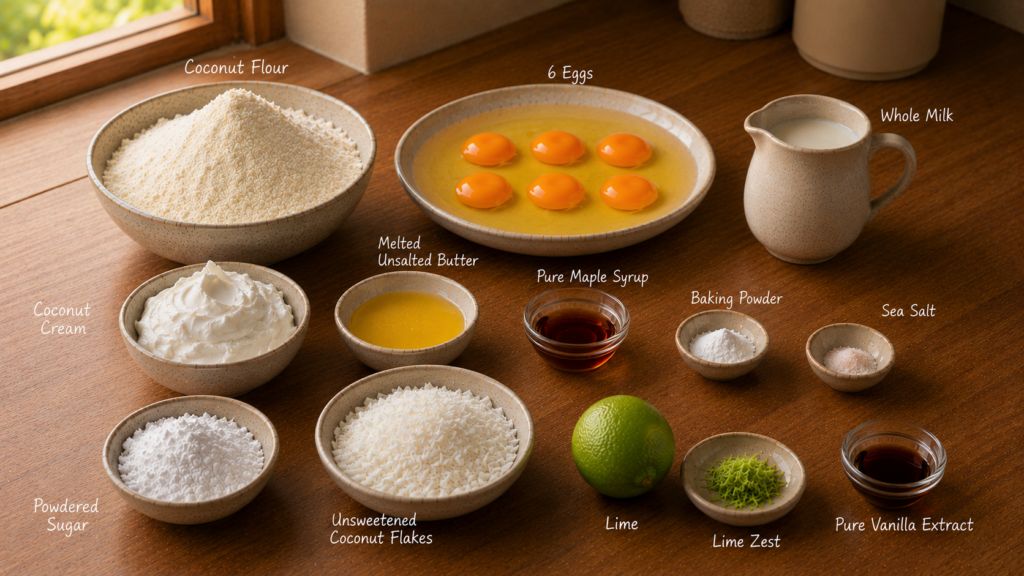
- 1/2 cup coconut flour, spooned and leveled, then sifted
- 6 large eggs, at room temperature
- 1/2 cup whole milk or full fat canned coconut milk
- 3 tablespoons unsalted butter or coconut oil, melted and cooled
- 2 tablespoons pure maple syrup
- 1 teaspoon baking powder
- 1 teaspoon pure vanilla extract
- 1/2 teaspoon fine sea salt
- 2 to 4 tablespoons additional milk, only if needed after resting
For cooking
- 2 tablespoons unsalted butter or coconut oil, added in stages
For the whipped coconut cream
- 1 can full fat coconut milk, 13.5 ounces, refrigerated upright overnight and undisturbed
- 2 tablespoons powdered sugar, sifted
- 1/2 teaspoon pure vanilla extract
- Pinch of fine sea salt
For serving
- 1/2 cup unsweetened coconut flakes, toasted
- Finely grated zest of 1 lime
- Warm maple syrup, to taste
Crockery and Time To Create
You will need a fine mesh sieve for the coconut flour, a large mixing bowl, a chilled bowl for the coconut cream, a balloon whisk or hand mixer, a rubber spatula, a small dry skillet for the flakes, a fine rasp grater for the lime, a quarter cup measure, a thin flexible metal spatula, and a matte charcoal grey cast aluminium griddle.
Prep time is 12 minutes. Resting time is 8 minutes. Cook time is 20 minutes. Total time is 40 minutes, plus overnight chilling for the coconut cream. This makes 12 small pancakes, which serves 4 people at 3 pancakes each.
Ingredient Substitutions and Variations
- Heavy cream: Swap the whipped coconut cream for regular whipped heavy cream if you are not keeping this dairy free, which whips faster and holds longer.
- Almond milk: Swap the whole milk for unsweetened almond milk, adding an extra tablespoon since coconut flour will drink it just as readily.
- Honey: Swap the maple syrup for honey in the batter, which browns slightly faster so drop the heat a touch.
- Coconut oil: Swap the butter for refined coconut oil in both the batter and the pan to keep the recipe fully dairy free.
- Lemon zest: Swap the lime zest for lemon when you want a softer citrus note that sits further back behind the coconut.
- Cinnamon: Add 1 teaspoon of ground cinnamon to the dry ingredients for a warmer, less tropical version.
- Fresh mango: Dice half a ripe mango over the finished stack for tropical acidity and colour against the pale pancakes.
Step-by-Step Instructions
Sift the Coconut Flour First
- Push the coconut flour through a fine mesh sieve into the mixing bowl, breaking up any clumps with the back of a spoon.
- Coconut flour compacts hard in the bag and forms dense lumps that never disperse once liquid goes in, leaving dry pockets in the finished pancake.
- Whisk in the baking powder and salt while the flour is still loose and aerated.
Toast the Coconut Flakes
- Spread the coconut flakes in a small dry skillet over medium low heat and toss them constantly for 3 to 4 minutes.
- They are ready when roughly two thirds have turned a light golden brown while the rest are still pale, which gives the best mix of colour and flavour.
- Tip them onto a plate immediately. Coconut flakes go from golden to burnt in about fifteen seconds and the residual heat of the pan will take them there.

Whisk the Eggs Thoroughly
- Crack all six eggs into a separate bowl and whisk for a full 45 seconds until pale, frothy, and completely uniform with no streaks of white remaining.
- This is not a step to rush. The eggs are doing the structural work that gluten would normally do, and unwhisked whites cook into visible rubbery patches.
- Whisk in the milk, cooled melted butter, maple syrup, and vanilla until smooth.
Combine and Rest Eight Minutes
- Pour the egg mixture into the flour and whisk immediately and vigorously until completely smooth, since coconut flour begins absorbing on contact.
- Let the batter stand undisturbed for 8 minutes. It will thicken dramatically during this time, moving from a thin pourable liquid to something closer to thick cake batter that mounds on a spoon.
- If it thickens into a paste that will not spread at all, whisk in milk a tablespoon at a time. This varies noticeably between brands of coconut flour.
Whip the Coconut Cream
- Open the chilled can without shaking it, scoop only the thick solid white cream from the top, and leave the watery liquid behind.
- Whip the solid cream with the powdered sugar, vanilla, and salt in a chilled bowl for 2 to 3 minutes until it holds soft peaks that fold over at the tip.
- Keep it in the fridge until the moment you serve, since whipped coconut cream softens faster than dairy cream does.
Heat the Griddle and Shape the Rounds
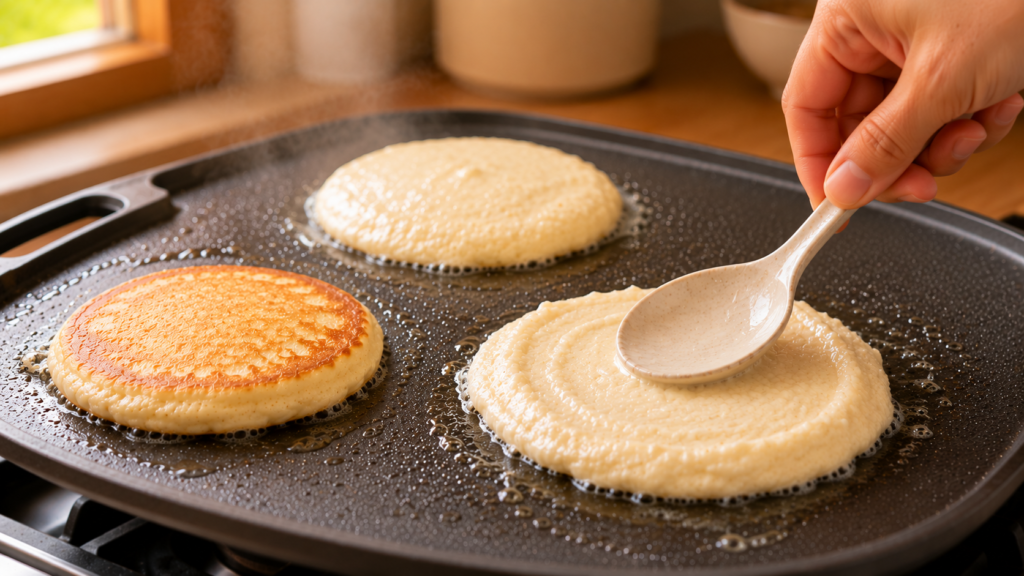
- Set the griddle over medium low heat, lower than for any wheat pancake, and let it come up slowly for 3 minutes before adding butter.
- Drop a scant quarter cup of batter and spread it into a 3 inch round with the back of the measure or a spoon, since this batter will not spread on its own at all.
- Keep them small. Coconut flour pancakes have no gluten holding them together and a large thin round will break apart the moment you try to turn it.
Cook Slow and Flip Carefully
- Cook for 3 to 4 minutes on the first side, considerably longer than a wheat pancake.
- Flip only when the edges have set completely firm and the underside is a warm medium golden brown. Slide a thin spatula fully underneath before committing, since these are the most fragile pancakes in this whole category.
- Cook 2 to 3 minutes on the second side. The interior crumb should be a pale creamy ivory, noticeably lighter than the golden exterior, dense but moist rather than airy.
Stack and Finish
- Stack the pancakes as they come off the griddle, keeping the most evenly browned one for the top.
- Spoon the whipped coconut cream on in one generous mound, then scatter the toasted coconut flakes across it.
- Grate the lime zest directly over the stack so the oils land on the cream, and serve immediately with warm maple syrup alongside.
Pro Tips for Best Results
- Measure the coconut flour by spooning and leveling rather than scooping, since a packed half cup can be nearly a third heavier and will turn the batter to paste.
- Refrigerate the coconut milk can upright and completely undisturbed for a full night, because shaking or tipping it remixes the cream and water and you will not get a clean separation.
- Cook these smaller than any other pancake, at around three inches, which is the single most effective fix for the fragility problem.
- Give the batter its full eight minutes rather than five, as coconut flour absorbs more slowly than almond or oat and an underrested batter spreads into thin lace.
- Buy coconut flour in smaller bags and store it sealed, since it absorbs moisture from the air and an old open bag behaves unpredictably.
Common Mistakes to Avoid
- Substituting coconut flour one for one: It absorbs several times more liquid than wheat or almond flour. Never scale it against another flour recipe.
- Skipping the sift: Compacted lumps do not break down in liquid and leave dry chalky pockets throughout. Sift every time.
- Undermixing the eggs: Six unevenly whisked eggs cook into rubbery white patches. Whisk them separately for a full 45 seconds first.
- Making them too large: Without gluten there is nothing holding a wide thin pancake together and it will tear on the flip. Keep them at three inches.
- Flipping too early: The edges must be completely firm, not just matte. Wait longer than instinct suggests.
- Shaking the coconut milk can: It remixes the cream and water and you lose the solid layer entirely. Open it standing upright and still.
What to Serve With
- Fresh mango slices: The bright acidity and tropical sweetness sit naturally beside coconut and cut the richness of the whipped cream.
- Plain coconut yogurt: A spoonful alongside keeps the plate dairy free while adding tang and a little more protein.
- Iced black coffee: The bitterness balances the maple and coconut, and something cold suits a plate this rich better than a hot drink does.

Storage and Reheating
- Fridge: Store cooled pancakes in an airtight container with parchment between the layers for up to 4 days, with the whipped coconut cream in a separate covered dish.
- Freezer: Freeze in a single layer on a tray until solid, then transfer to a freezer bag for up to 2 months. These freeze better than most grain free pancakes.
- Reheating from the fridge: Warm in a dry pan over low heat for 90 seconds per side, which restores the surface without drying the dense crumb.
- Reheating from frozen: Warm at 300F for 8 to 10 minutes rather than toasting, since the fragile edges catch quickly in a toaster.
- Whipped coconut cream: It stiffens in the fridge and will need 30 seconds of whisking to come back to a spoonable texture.
Nutrition Information
| Nutrient | Per Serving |
|---|---|
| Calories | 446 kcal |
| Total Fat | 34 g |
| Saturated Fat | 22 g |
| Cholesterol | 294 mg |
| Sodium | 438 mg |
| Total Carbohydrate | 21 g |
| Dietary Fiber | 12 g |
| Total Sugars | 9 g |
| Protein | 20 g |
| Potassium | 436 mg |
| Iron | 4 mg |
| Nutrition values are estimates calculated per serving of 3 pancakes with whipped coconut cream and toasted flakes, and will vary based on the coconut flour brand, milk choice, and exact quantities used. | |
Health Benefits
Coconut flour carries an unusually high fiber load, with twelve grams per serving here, almost all of it insoluble fiber from the coconut meat left after the oil is pressed out. That fiber is why the net carbohydrate count sits at only nine grams despite the flour being a carbohydrate source.
Six eggs across the batch deliver complete protein along with choline, a nutrient involved in memory and liver function that most people fall short on. The fat in coconut contains medium chain triglycerides, which the body metabolises differently from longer chain fats, though the practical effect at breakfast portions is modest.
Conclusion
Coconut flour is the least forgiving flour in a home kitchen and it punishes anyone who treats it like the others. Sift it, give the batter its full rest, and keep the pancakes small. Do those three things and you get a dense tender pancake with real protein behind it. Save the recipe and tell me which brand of flour you used.