Rosemary Sea Salt Focaccia with Crispy Olive Oil Crust
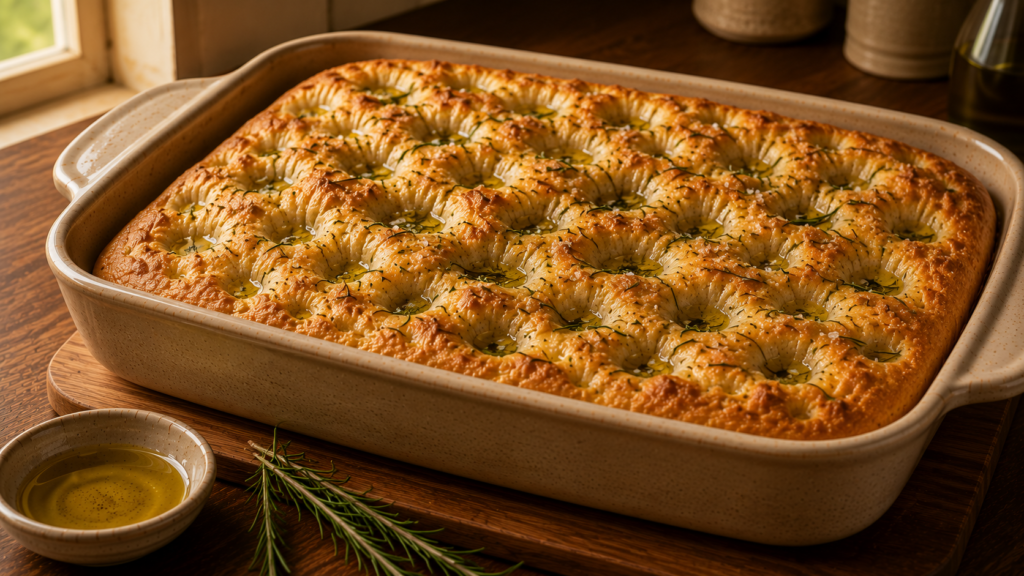
The dimples in focaccia are not decorative. They are functional. Press them deep enough and they hold pools of olive oil that fry the bottom of the dough from underneath while the top bakes golden from above, creating two entirely different textures in one bread simultaneously.
This rosemary sea salt focaccia uses a high-hydration dough and a generous pour of good olive oil to produce a bread that is crisp on the outside, airy and open-crumbed inside, and fragrant with herbs from the first pull.
Why You Will Love This Recipe
- A high-hydration dough with a long cold overnight rest develops deep flavor and an open, bubbly crumb structure that no same-day quick focaccia can replicate regardless of how much oil is added.
- The olive oil that floods the pan before and after shaping fries the base during baking into a deeply golden, almost crackerlike bottom crust that contrasts the soft, airy interior in the most satisfying way.
- Fresh rosemary pressed into the dimples before baking infuses the oil around it as it cooks, flavoring the entire bread from inside the dough rather than just sitting on the surface.
- Flaky sea salt scattered over the top right before the oven goes in dissolves partially into the olive oil during baking and creates pockets of intense seasoning that make each bite more complex than the ingredient list suggests.
- This bread is genuinely forgiving — the high oil content and hydration mean small errors in shaping or timing rarely affect the final result in any meaningful way.
Ingredients
For the focaccia dough:
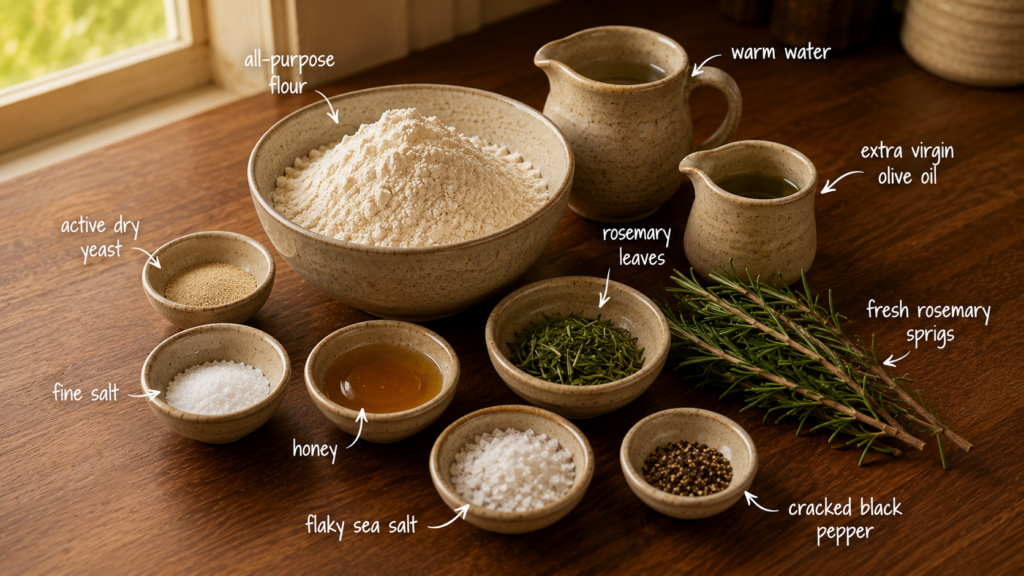
- 4 cups all-purpose flour or bread flour
- 2 teaspoons fine salt
- 1 and 3/4 teaspoons active dry yeast, just under one standard packet
- 1 and 3/4 cups warm water, between 100 and 110 degrees Fahrenheit
- 1 teaspoon honey
- 3 tablespoons extra virgin olive oil, for the dough
For the pan and topping:
- 4 tablespoons extra virgin olive oil, for the pan
- 2 tablespoons extra virgin olive oil, for the surface dimpling
- 3 sprigs fresh rosemary, leaves stripped
- 1 and 1/2 teaspoons flaky sea salt
- 1/2 teaspoon freshly cracked black pepper, optional
Use the best olive oil you can reasonably afford for this recipe. Focaccia is built almost entirely on flour, water, yeast, and oil — the oil is not a background ingredient here, it is a structural and flavor component, and a flat, bitter, low-quality oil produces a flat, bitter focaccia regardless of how well everything else is executed.
Crockery and Time To Create
You will need one large mixing bowl, a 9 by 13 inch rimmed baking pan with at least 2-inch sides or a 10 by 14 inch rimmed baking sheet, plastic wrap for the overnight rest, and a pastry brush. Total time is 20 hours including the overnight cold ferment plus 2 hours of room temperature proofing. Active work time is under 20 minutes across the whole process. The recipe makes one full pan serving 8 to 10 people.
Ingredient Substitutions and Variations
- Bread flour: replaces all-purpose flour and produces a chewier, slightly more structured focaccia with a more pronounced pull and a more open crumb due to its higher protein content.
- Instant yeast: replaces active dry yeast at 3/4 of the quantity listed and can be added directly to the flour without proofing in water first, which shortens the initial mixing slightly.
- Thyme: replaces rosemary for a more delicate, slightly floral herb note that works particularly well if serving alongside roasted chicken or fish.
- Sliced olives: press into the dimples alongside or instead of rosemary for a briny, savory topping that turns the bread into something that needs no accompaniment at all.
- Caramelized onions: spread thinly across the surface before the rosemary and salt for a sweet, jammy topping layer that makes this bread substantial enough to serve as a light meal on its own.
Step-by-Step Instructions
- The night before baking, make the dough. In a large mixing bowl combine the warm water, honey, and yeast. Stir gently and leave for 5 minutes until the surface shows a thin foam. Add the flour, fine salt, and 3 tablespoons of olive oil. Mix with a fork or your hands until no dry flour remains and a shaggy, sticky dough forms. It will be wetter than any bread dough you have made before, which is correct.
- Cover the bowl tightly with plastic wrap and refrigerate for a minimum of 8 hours and up to 18 hours. The cold fermentation is where the flavor and the open crumb structure develop. Do not skip this step or shorten it significantly.
- The next day, pour 3 tablespoons of the olive oil for the pan into your baking pan and tilt to coat the base completely. Scrape the cold dough directly out of the refrigerator bowl into the oiled pan. Pour the remaining 1 tablespoon of pan olive oil over the top of the dough. Use your fingertips to gently stretch and coax the dough toward the corners of the pan without tearing it. It will resist and spring back. That is normal. Cover the pan loosely and leave at room temperature for 2 hours. The dough will relax and spread toward the edges on its own during this rest.
- After 2 hours the dough should have spread significantly toward the pan edges and look noticeably puffed. If it has not fully reached the corners, use oiled fingertips to gently push it the remaining distance without deflating the bubbles that have formed.
- Preheat your oven to 425 degrees Fahrenheit with a rack in the lower third of the oven. Drizzle the 2 tablespoons of surface olive oil over the dough. Dip all ten fingertips into the oil and press them firmly and deeply into the dough all the way to the pan base, moving across the whole surface methodically to create the characteristic dimple pattern. Do not be gentle with this step. Deep dimples hold the oil and create the fried pockets in the finished bread. Shallow dimples close back up in the oven.
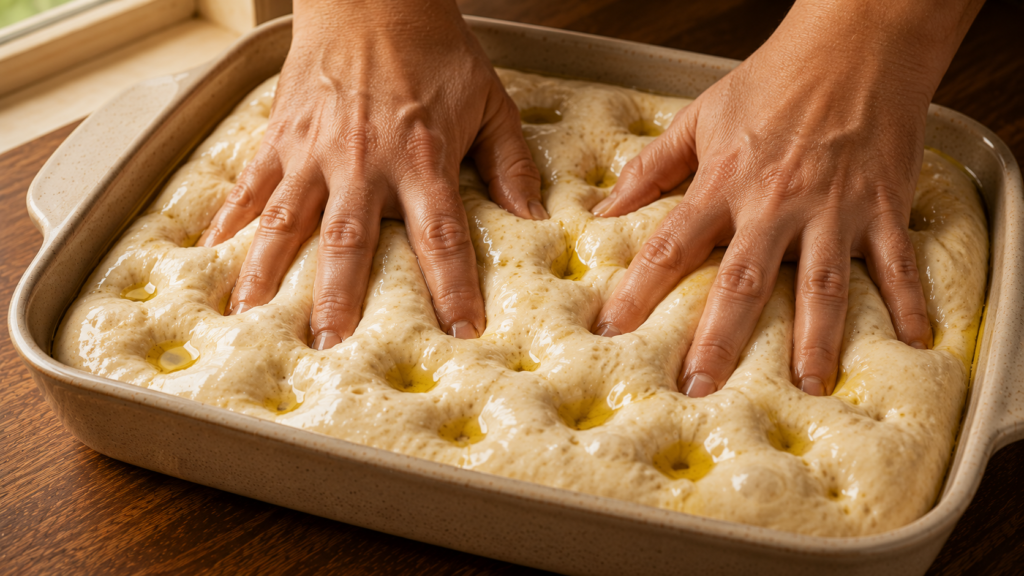
- Scatter the stripped rosemary leaves into the dimples and across the surface, pressing each sprig lightly so it sits in the oil rather than on top of the dough. Sprinkle the flaky sea salt evenly across the entire surface. Add cracked black pepper if using.

- Bake for 22 to 26 minutes until the top is deeply golden brown across the entire surface and the edges are pulling away from the pan sides. The base should be audibly crackling when you lift a corner with a spatula — a pale base means the bread needs another 3 to 4 minutes.
- Remove from the oven and slide the focaccia immediately out of the pan onto a wire rack. If it sits in the hot oil in the pan after baking the base will continue to fry and can become too dark. Cool for at least 15 minutes before cutting.
Pro Tips for Best Results
- Do not reduce the amount of olive oil in the pan below what the recipe states. The oil is not excess — it is the mechanism that fries the base. A focaccia baked with too little oil will have a pale, dry base that lacks the characteristic crispness.
- Press the dimples all the way to the bottom of the pan every time. Focaccia dimples that are half-hearted or shallow close up during baking and leave the surface flat. Go deep with confidence.
- Slide the baked focaccia out of the pan immediately rather than leaving it to cool in the pan, because the base continues to fry in the residual hot oil after the oven heat is removed, and a few extra minutes can take it from crisp to too dark.
- Taste the dough after mixing and before the overnight rest. It should taste lightly salty. Focaccia dough that tastes bland at the mixing stage will taste bland after baking regardless of the salt scattered on top.
- If the dough has not spread fully to the pan corners after 2 hours at room temperature, oil your fingertips and gently stretch it rather than pressing new dimples. The bubbles formed during the cold rest are the open crumb structure and should not be deflated by aggressive pressing before the dimpling stage.
Common Mistakes to Avoid
- Rushing the cold ferment: a same-day focaccia made without the overnight rest will taste of raw yeast rather than developed bread flavor and the crumb will be tight and cakey rather than open and airy. The overnight rest is not optional for this recipe.
- Using too little olive oil: a focaccia baked with a conservative amount of oil will have a soft, pale base rather than the golden, slightly fried bottom crust that defines the bread. More oil, not less.
- Pressing shallow dimples: dimples that do not reach the pan bottom close up in the oven heat as the dough rises further. Press firmly and deeply with all ten fingertips every time.
- Cutting immediately out of the oven: the steam inside the bread needs at least 15 minutes to redistribute or the interior crumb will be gummy and the oil will pool visibly when cut. Cool on the rack before cutting.
What to Serve With
- Burrata and heirloom tomatoes: torn focaccia alongside creamy burrata and ripe tomatoes with a drizzle of the same olive oil used in the bread is a combination that needs nothing else on the table.
- Roasted garlic and olive oil dipping bowl: a small bowl of warm roasted garlic pressed into olive oil alongside torn focaccia is a starter that makes the bread the entire point of the meal.
- Beef minestrone soup: the focaccia works perfectly as a dunking bread alongside a rich, hearty minestrone, the olive oil crust holding its structure in the broth far longer than a soft dinner roll would.

Storage and Reheating
- Room temperature: store cooled focaccia loosely wrapped or in a paper bag for up to 2 days. Do not store airtight as this softens the crust.
- Fridge: refrigerate for up to 4 days. The crust softens in the cold but the flavor improves. Reheat before serving.
- Freezer: freeze cut pieces in a sealed bag for up to 2 months. Thaw at room temperature then reheat in the oven.
- Reheating: place cut pieces directly on an oven rack at 375 degrees Fahrenheit for 6 to 8 minutes. This re-crisps the base and top without drying the interior. An air fryer at 350 degrees Fahrenheit for 3 to 4 minutes works equally well.
Nutrition Information
| Nutrient | Per Serving (1 piece) |
|---|---|
| Calories | 298 kcal |
| Carbohydrates | 42 g |
| Protein | 6 g |
| Fat | 12 g |
| Saturated Fat | 1.5 g |
| Cholesterol | 0 mg |
| Sodium | 420 mg |
| Fiber | 1.5 g |
| Sugar | 1 g |
| Nutrition values are estimates only and will vary based on specific ingredients and portion sizes used. | |
Health Benefits
Extra virgin olive oil is the nutritional backbone of this bread in a way that sets it apart from butter-enriched or oil-free breads. The polyphenols in high-quality extra virgin olive oil, particularly oleocanthal and oleuropein, have well-documented anti-inflammatory properties that survive moderate baking temperatures, meaning a meaningful portion of those compounds remains active in the finished bread. The fat profile is predominantly monounsaturated, which research consistently associates with improved cardiovascular markers and reduced low-density lipoprotein oxidation.
The long cold fermentation breaks down a portion of the phytic acid in the flour, improving the bioavailability of the iron, zinc, and magnesium present in the wheat. This is the same mechanism that makes sourdough bread more digestible than commercially yeasted same-day bread, and an overnight cold ferment produces a comparable improvement without requiring a sourdough starter or the extended timeline that true sourdough demands.
Conclusion
Focaccia is the most rewarding bread for the amount of active effort it requires, and the overnight cold rest is the single step that separates a genuinely excellent focaccia from a decent one. Mix it the night before, bake it the next afternoon, and tear into it warm with good olive oil on the table. Save the recipe, use good oil, and do not be shy with the dimples.